Felix Roth · 15 October 2026
Thermal Dynamics in Curved Structure Designs for Hot Climate Adaptation Strategies
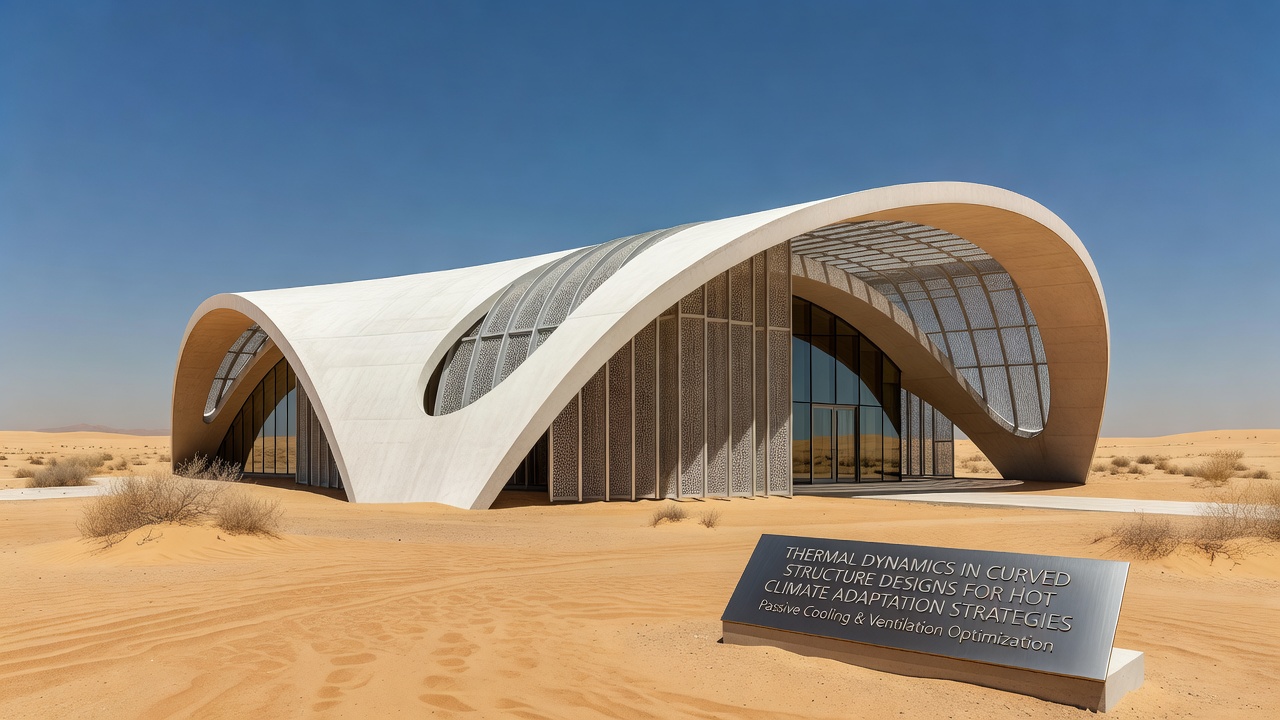
Curved structure designs have drawn attention from architects and engineers working on buildings suited to hot climates because these forms alter how heat moves through surfaces and air volumes. Data from field measurements show that spherical and domed geometries reduce direct solar exposure compared with flat roofs while directing convective currents that carry warm air upward and outward through strategic vents. Researchers at institutions in arid regions have documented temperature differentials of up to 8 degrees Celsius between interior and exterior spaces during peak afternoon hours when curved shells incorporate reflective coatings and insulated layers.
Heat Transfer Mechanisms in Curved Forms
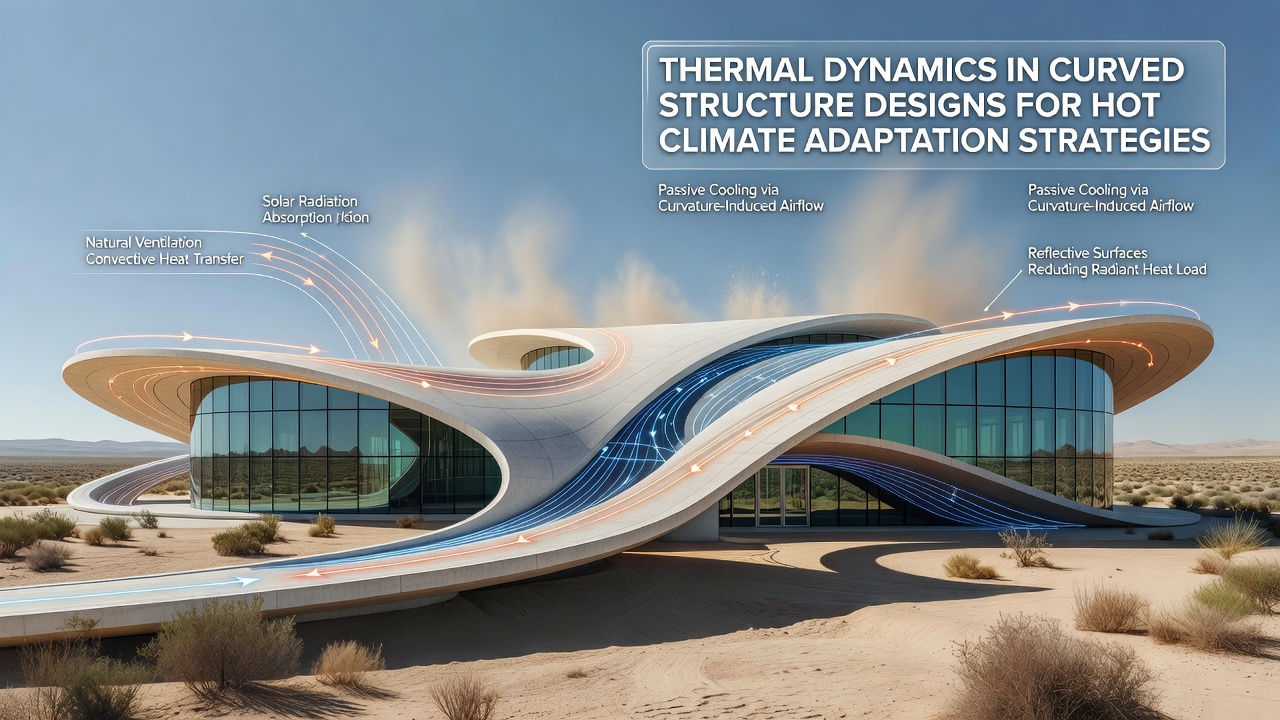
Conduction, convection, and radiation interact differently when walls and roofs follow continuous curves rather than straight planes. The continuous surface minimizes thermal bridges at joints because fewer linear seams interrupt the material path, and this continuity allows heat to distribute more evenly across the shell. Studies conducted in the southwestern United States indicate that geodesic domes with double-layer membranes maintain interior surface temperatures several degrees lower than adjacent rectangular buildings during summer months when both structures receive identical solar loads. Engineers note that the curvature also influences boundary layer airflow, creating a thin film of moving air that reduces conductive heat gain through the envelope.
Airflow Patterns and Ventilation Strategies
Inside domed volumes, warm air rises along the inner surface and collects at the apex, where exhaust openings can release it without mechanical assistance. Computational fluid dynamics models produced by European research centers confirm that placing low-level intakes on the shaded side of a curved building generates a steady pressure differential that pulls cooler outside air inward. In October 2026, updated simulation tools released by an Australian government research agency incorporated real-time wind data from multiple desert stations, revealing that curved structures oriented with their longest axis perpendicular to prevailing winds achieve 22 percent higher natural ventilation rates than earlier static models predicted. These findings align with observations from field installations in the Middle East where passive stack ventilation through apex vents maintains comfortable conditions during extended heat waves.
Material Choices and Surface Treatments
Selection of exterior finishes plays a central role in managing radiative heat gain on curved surfaces. High-albedo coatings applied to dome exteriors reflect a larger fraction of incoming solar radiation, and manufacturers have developed elastomeric membranes that retain flexibility across wide temperature swings common in desert environments. According to data compiled by a Canadian university laboratory specializing in building envelope performance, curved panels finished with cool-roof pigments showed a 35 percent reduction in absorbed solar energy compared with standard concrete surfaces under identical irradiance levels. Interior linings often incorporate phase-change materials that absorb excess heat during daylight hours and release it slowly after sunset, stabilizing daily temperature swings inside the enclosed space.
Case Examples from Hot Climate Regions
Projects in the southwestern United States and northern Australia illustrate practical application of these principles. One installation near Tucson incorporated a 12-meter-diameter geodesic dome with automated ridge vents that responded to interior temperature sensors, maintaining average daily interior temperatures below 28 degrees Celsius without supplemental cooling during summer test periods. In parallel, researchers in the United Arab Emirates examined smaller curved shelters used for agricultural storage, finding that the geometry reduced peak internal humidity fluctuations by limiting direct solar penetration through the roof plane. These installations demonstrate that curved forms integrate well with earth-berm techniques, where the lower portion of the structure sits partially below grade to further moderate heat exchange with the surrounding soil.
Modeling and Performance Validation
Advanced modeling tools now allow designers to predict thermal behavior before construction begins. Software packages developed through collaborations between academic teams in the European Union and industry partners incorporate solar angle calculations, material thermal properties, and local wind roses to generate hour-by-hour temperature profiles. Validation studies compare these predictions against sensor data collected from occupied structures, and discrepancies typically fall within 1.5 degrees Celsius when input parameters reflect actual site conditions. Such accuracy supports iterative refinement of vent placement and insulation thickness during the design phase, reducing the need for post-construction modifications.
Conclusion
Thermal dynamics in curved structure designs continue to inform adaptation strategies for hot climates as measurement techniques and material options advance. Observers note that ongoing data collection from existing installations provides benchmarks that guide future projects, while regulatory frameworks in multiple regions increasingly reference performance metrics derived from curved-form studies when setting efficiency standards for new construction.